
Usually, I write about emotions — the invisible storms people carry within themselves.
About loneliness, overthinking, healing, longing, and the quiet wars that shape us internally.
But today feels different.
Today, I want to write about something far less discussed, yet far more dominant in most of our lives — work.
That one quadrant of life that silently consumes our time, our energy, our youth, our identities.
The space where ambition and survival shake hands.
Where personalities are not just revealed, but manufactured.
Where resilience is not motivational theory, but daily currency.
A few weeks ago, during a long conversation, I was speaking to my friend VK.
A banker – But reducing him to that designation would miss the point entirely.
VK is the kind of person who notices what others overlook.
Calm in chaos – Measured with words.
Someone who does not speak to impress — but when he finally says something, it stays with you long after the conversation ends.
For the last one and a half years, he has been travelling relentlessly across Eastern and North-Eastern India — regions often discussed in corporate meetings through growth percentages, targets, and balance sheets, but rarely understood for their people, psychology, struggles, and emotional landscapes.
What started as a professional assignment slowly became something much larger.
A front-row seat to understanding India beyond airports, presentations, and metropolitan assumptions.
Not just banking.
But human behaviour.
Leadership.
Identity.
Trust.
Fear.
A lesson in how geography shapes ambition and how culture shapes survival.
And somewhere in the middle of that conversation, VK said something that refused to leave my mind:
“India is not one country emotionally.”
The sentence sounded simple.
But the more I sat with it, the heavier it became.
We often discuss India as:
- one economy,
- one market,
- one growth story.
But according to him, India behaves less like one market and more like multiple emotional civilizations functioning together under one national identity.
“Every zone in India negotiates differently,” I remember adding during the conversation.
“The North respects assertion.
The West respects performance.
The South respects structure.
But the East… the East first studies your intent.”
And the more we unpacked that thought, the more we realised this was not merely about business geography.
It was about emotional geography.
Because markets are never built only on economics.
They are built on collective memory.
And perhaps that is where many leadership teams sitting inside metropolitan boardrooms misread Eastern India entirely.
Eastern India is not challenging because the people are difficult.
It feels challenging because history itself has been difficult here.
VK paused for a moment before saying something that stayed with me:
“Regions that have experienced uncertainty for decades develop a very different relationship with trust.”
And suddenly, everything began making sense.
The East carries generations of layered experiences:
Political shifts that altered public confidence.
Economic stagnation that slowed industrial momentum.
Migration that pulled talent away from home states.
Labour movements that shaped organisational behaviour.
Floods and geographical vulnerabilities that repeatedly disrupted stability.
Identity-driven movements that made communities protective of their space and culture.
And decades of uneven infrastructure growth compared to other parts of India.
When development arrives inconsistently, people naturally become more observant before they commit.
Not resistant.
Observant.
Infrastructure gaps create caution.
Delayed institutional delivery creates scepticism.
Years of underrepresentation create emotional distance from authority.
And therefore, whether you are building presence in:
banking,
automobiles,
retail finance,
insurance,
logistics,
real estate,
or infrastructure —
you are not entering only a market.
You are entering accumulated memory.
That changes the rules of growth entirely.
VK told me something fascinating from his field experience:
“In many places, before people evaluate your proposal, they evaluate your behaviour.”
How you speak to your junior staff.
How patiently you listen.
Whether you disappear after the first meeting.
Whether your promises survive beyond presentations.
Whether you arrive only for targets — or stay long enough to build relationships.
Because in large parts of Eastern and North-Eastern India, emotional credibility often arrives before commercial credibility.
And that insight is strategically powerful.
Most businesses enter emerging markets with speed-oriented thinking:
penetration, conversion, expansion, numbers.
But markets shaped by historical caution move differently.
Here, trust compounds before revenue does.
The first win is not transaction.
The first win is acceptance.
And once acceptance comes, loyalty often becomes far deeper than what transactional markets can offer.
That is the paradox many organisations fail to understand.
Some regions buy products quickly.
Some regions buy intent first.
VK spends a considerable amount of time in West Bengal, and according to him, Bengal is perhaps one of the most intellectually layered business cultures in India.
Not necessarily the fastest.
Not the loudest.
But deeply perceptive.
“People here analyse you silently,” he told me that ,they value respect more than aggression.
And that observation says a lot about Bengal’s professional psychology.
Unlike highly transactional markets where speed and dominance often drive business outcomes, Bengal operates through something more nuanced — intellectual engagement and emotional respect.
People observe before they respond.
They listen between sentences.
They assess not only competence, but temperament.
In many ways, business conversations here resemble cultural conversations.
Corporate aggression rarely sustains trust for long.
Over-selling creates resistance.
Hierarchy without humility creates distance.
Instead, the ecosystem responds better to:
patience,
conversational intelligence,
emotional maturity,
and leaders who know how to build dialogue rather than merely push decisions.
“Even clients want conversation,” VK explained.
“They don’t want to feel processed.”
That line stayed with me because it captures a larger truth about relationship-driven markets.
In Bengal, people often want acknowledgment before agreement.
They want context before commitment.
And once they feel heard, the resistance reduces naturally.
Interestingly, VK noticed the same behavioural pattern internally within teams as well.
Leadership here cannot operate only through instruction.
People respond far better to:
inclusion,
listening,
shared ownership,
and collaborative decision-making.
Respect, in many Eastern ecosystems, is not automatically granted by designation alone.
It is earned through conduct.
And once trust is built, the loyalty becomes remarkably deep — not performative loyalty, but emotional investment in the institution and its people.
When our discussion shifted towards the North-East, VK became even more reflective.
“One mistake outsiders make,” he admitted honestly, “is assuming the North-East is one emotional or cultural block.”
“It is not one region,” he corrected himself.
“It is many identities, many histories, many emotional worlds.”
And perhaps that was his biggest leadership learning of all.
Because leadership often fails when it oversimplifies people.
The North-East cannot be understood through maps alone.
Every state carries its own social rhythm, historical memory, political sensitivity, linguistic identity, and relationship with institutions.
And therefore, authenticity becomes non-negotiable.
“You cannot fake authenticity here,” VK said.
People quickly sense whether someone is genuinely interested in understanding the region — or merely completing a business mandate.
Surface-level engagement fails fast.
Which is why VK believes one of the biggest mistakes organisations make while entering Eastern and North-Eastern India is approaching the region purely through target pressure and expansion metrics.
Because growth here does not arrive through aggression alone.
It comes through continuity.
Through showing up consistently.
Through empowering local teams instead of controlling them remotely.
Through respecting cultural intelligence instead of imposing corporate uniformity.
Through relationship memory built over time.
In many ways, Eastern India teaches a leadership lesson modern corporations desperately need:
People may initially listen to your designation.
But eventually, they respond only to your intent.
And honestly, that may be one of the most underestimated business truths in India today
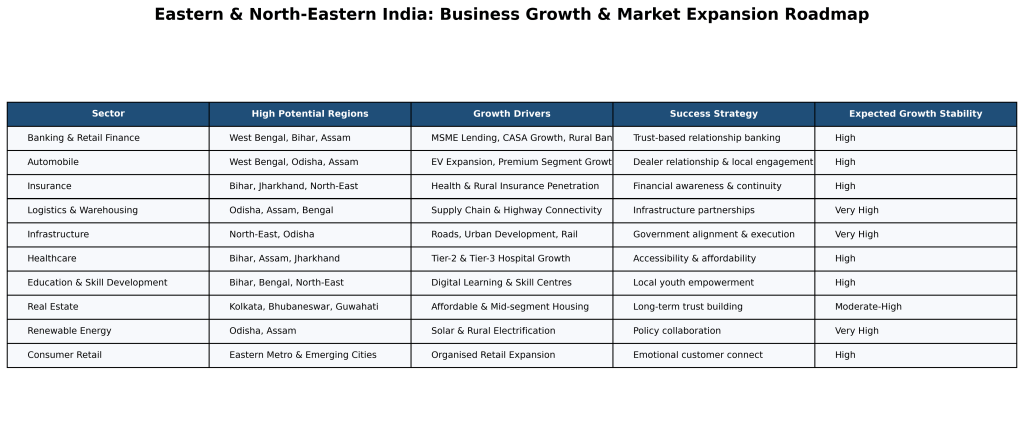
Vk summarised :
 Molika's Blog
Leave a comment