
“The only thing we have to fear is fear itself.”
— Franklin D. Roosevelt
While reading the book “The Power of Subconscious Mind”, where Murphy explains how releasing fear allows the subconscious mind to operate effectively, without the restrictions of anxiety or self-doubt. It was so relatable, when I glanced back to my past and saw that whenever I was anxious and was unable to see anything clearly I feared the outcome, but when I just sat down and put across what’s all in my mind on a piece of paper, and was able to define the problem or concern clearly, I was also able to see the solutions and then the fear of outcome was gone.
If it’s so simple then why & how during this life span we got messed up? , I have many friends, guides and coaches in my circle who have been searching and sharing their insights about this at various instances, and I find it very fascinating that on the surface, our mind, makes us feel that finding inner peace or clarity sounds simple, yet finding it, and sustaining it, is challenging. Living a life free from fear, anxiety, or emotional baggage is a difficult mix, and is dependent on psychological conditioning, social influences, and personal experiences that gradually shape our thoughts, emotions, and behaviors over a lifetime.
I would like to divide this into two sections:
- Why Fear Based Thinking Develops?
- Early Conditioning
- Survival Instincts
- Emotional Experiences
- Cognitive Distortions
- Influence of Authority Figures
- Past Trauma
- Social Comparisons
- Unmet Emotional Needs
- How Fear Based Thinking is Reinforced?
- Lack of Emotional Education
- Self-Perception
- Perfectionism
- Reinforced Neural Pathways
- Over-identification with Thoughts
- Reliance on Control
- Media Influence
- Peer Pressure
As we mature with our life experiences, I am sure most of you reading this will relate and understand that we are aware of these why’s & how’s , but still, Are we able to have a “True thinking mindset” all the time? The answer is “No”. So, here are two ways widely suggested by therapists for achieving a fear free mindset: 1. Mindfulness and 2. Emotional Regulation.
Research from Harvard University suggests that practicing mindfulness can reduce time spent in mind-wandering or worry (often fear-based) by up to 47% throughout the day. Although it doesn’t necessarily eliminate fear-based thinking, it suggests that a mindful person could reduce the time spent on fear-based thoughts significantly through awareness and practice.
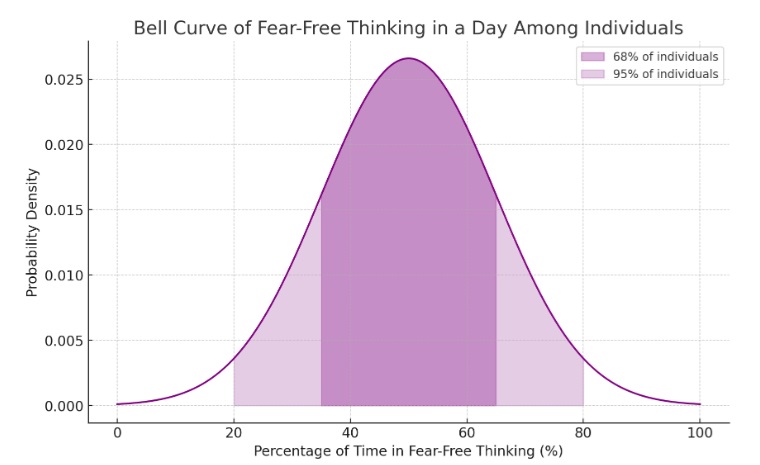
Here is a bell curve illustrating the distribution of time that individuals spend in fear-free thinking throughout the day. The curve is centered around 50%, with most people (68%) spending between 35% and 65% of their day in fear-free thought processes, while a wider range (95%) spends between 20% and 80% of their time in this state. The graph shows that while many people can achieve significant periods of fear-free thinking, only a smaller group maintains a high percentage of it consistently.
“Fear defeats more people than any other one thing in the world.”
— Ralph Waldo Emerson
 Molika's Blog
Leave a comment